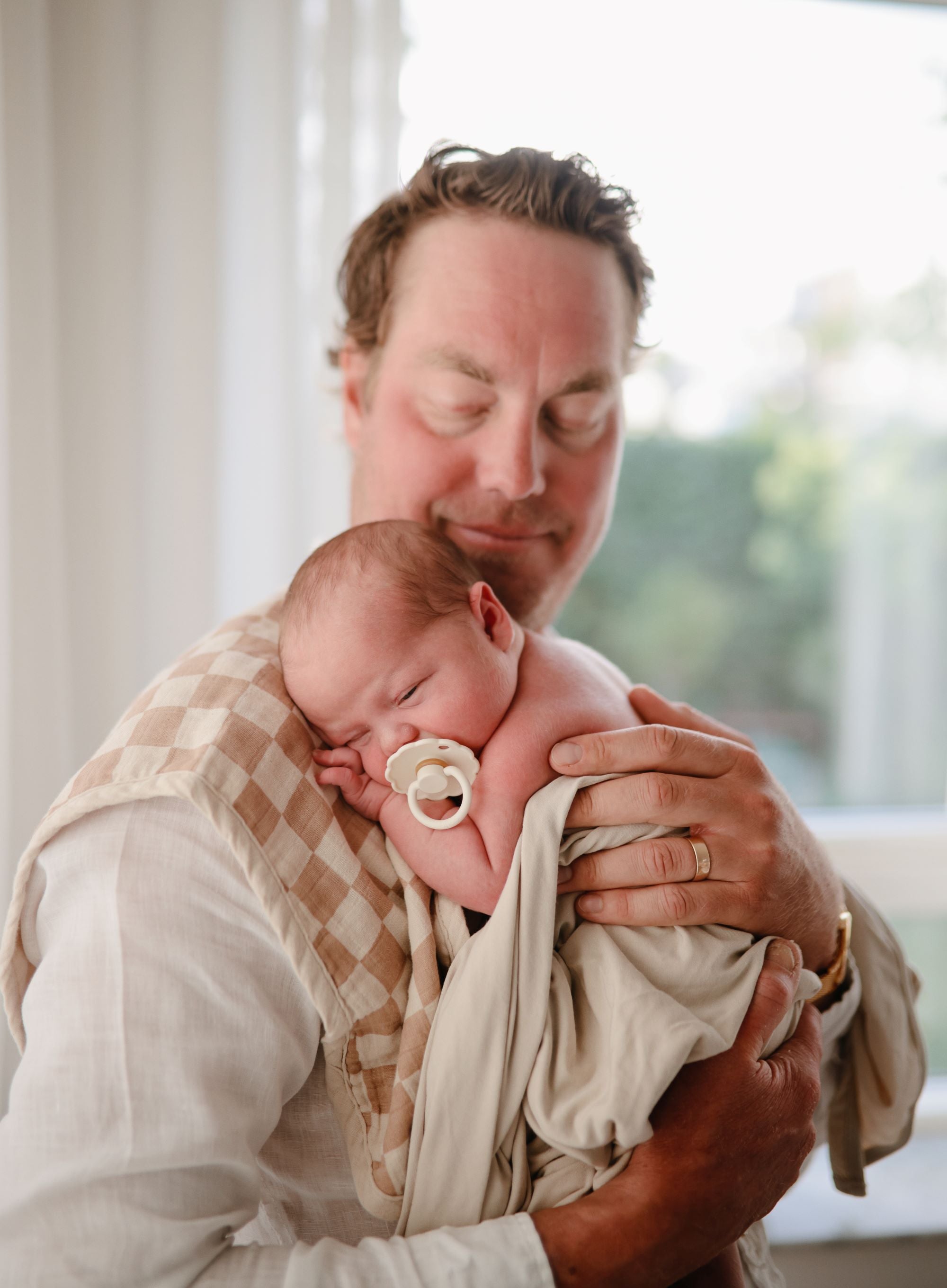
Many parents look forward to the first night their baby sleeps without waking. But before asking when that might happen, it helps to understand how newborn sleep naturally develops over time.
It's 2:13 in the morning.
After nearly an hour of feeding, cuddling, and gently settling your baby, you've finally made it back to bed.
You close your eyes.
A few minutes later, you hear that familiar cry again.
If this sounds familiar, you're not alone.
Almost every new parent reaches a point where they quietly wonder:
"When will my baby finally sleep through the night?"
Friends and family often have an answer ready.
"Around three months."
"Once they start solids."
"You just need the right bedtime routine."
"Don't let them sleep too much during the day."
These suggestions are usually well intended.
But they can also create the impression that healthy sleep follows a predictable schedule.
The reality is much more reassuring.
Newborn sleep doesn't develop according to a calendar.
It develops according to biology.
And perhaps the more helpful question isn't "When will my baby sleep through the night?"
It's:
"How does newborn sleep develop in the first place?"
Why Don't Newborns Sleep Through the Night?
Many adults think of sleep as something automatic.
We feel tired.
We fall asleep.
We stay asleep until morning.
For newborn babies, sleep works very differently.
At birth, their brains and bodies are still adapting to life outside the womb.
Their internal body clock hasn't fully learned the difference between day and night.
Their stomachs are small, so they need to feed frequently—including overnight.
Their sleep cycles are also much shorter than those of older children and adults.
In other words, waking often isn't usually a sign that something is wrong.
For most healthy newborns, waking during the night is an expected and important part of early development.
Instead of asking why your baby isn't sleeping like an adult, it may be more helpful to ask:
How is my baby's sleep gradually maturing over time?
Sleep Is a Developmental Process
One of the biggest misconceptions about infant sleep is that babies simply need to "learn" how to sleep.
In reality, sleep is something that develops.
Just like lifting their head.
Rolling over.
Sitting independently.
Or taking their first steps.
Longer stretches of sleep emerge as the brain, nervous system, circadian rhythm, and feeding patterns mature.
This isn't something parents can rush.
Nor does it happen on exactly the same timeline for every baby.
Two babies of the same age may have completely different sleep patterns.
Both may still be developing exactly as expected.
What to Expect During the First Month
The first few weeks often feel like one long day that blends into one long night.
Most newborns will:
- sleep in relatively short stretches;
- wake frequently to feed;
- have little distinction between daytime and nighttime sleep;
- stay awake only briefly before becoming sleepy again.
For exhausted parents, this rhythm can feel overwhelming.
Yet it serves an important biological purpose.
Frequent feeding supports rapid growth.
Shorter sleep cycles reflect a nervous system that is still maturing.
Understanding this doesn't necessarily make the nights easier.
But it often makes them easier to understand.
And understanding can be surprisingly reassuring.
What Does "Sleeping Through the Night" Actually Mean?
One of the most common sources of confusion is the phrase:
"My baby sleeps through the night."
It sounds simple.
Yet it doesn't always mean the same thing.
Many parents imagine a baby sleeping peacefully from 7:00 p.m. until 7:00 a.m. without waking once.
In reality, that's not how the term is commonly used in infant sleep research.
Many studies define sleeping through the night as a baby sleeping for approximately six to eight consecutive hours, even if they wake later to feed or briefly stir between sleep cycles.
This distinction matters.
Because when another parent says,
"My baby already sleeps through the night,"
they may be describing something very different from what you're imagining.
Understanding the language helps us build more realistic expectations.
And realistic expectations often reduce unnecessary worry.
When Do Babies Start Sleeping for Longer Stretches?
This is perhaps the question every sleep-deprived parent hopes has a simple answer.
Unfortunately, babies don't follow a universal timeline.
Instead, longer periods of uninterrupted sleep tend to appear gradually as several aspects of development mature together.
Over time, many babies begin to:
- sleep for longer stretches during the night,
- become more efficient at feeding,
- develop a clearer distinction between day and night,
- gradually wake less often overnight.
Some babies reach these milestones earlier.
Others take considerably longer.
Both experiences can fall within the wide range of normal development.
Rather than comparing your baby with another child of the same age, it is often more helpful to notice how your own baby's sleep has changed over the past few weeks or months.
Development is usually easier to see over time than from one difficult night to the next.
How Parents Can Support Healthy Sleep Development
Parents often ask,
"Is there anything I can do to help my baby sleep better?"
The answer is yes—but perhaps not in the way many people expect.
Parents cannot speed up biological maturity.
What they can do is create an environment that supports healthy sleep development.
Simple everyday habits can make a meaningful difference, including:
- exposing your baby to natural daylight during the morning and daytime;
- keeping nighttime feeds calm, quiet, and dimly lit;
- learning to recognise your baby's early sleepy cues before they become overtired;
- establishing a gentle, age-appropriate bedtime routine;
- and responding consistently to your baby's feeding and comfort needs.
These habits don't "teach" a newborn to sleep through the night.
Instead, they support the gradual development of healthy sleep rhythms.
When Night Waking Is Usually Normal
After several interrupted nights, it's understandable to wonder whether something is wrong.
In most healthy newborns, however, waking frequently is expected.
It is common for newborns to:
- wake every few hours to feed;
- have short sleep cycles;
- move, stretch, make noises, or briefly open their eyes while asleep;
- have days when sleep seems more fragmented than usual.
These patterns can be surprising for first-time parents because they differ so much from adult sleep.
But they are often signs of an immature sleep system—not signs of failure.
As babies grow, these patterns gradually become more organised.
The change is usually progressive rather than sudden.
When Should Parents Seek Medical Advice?
Although variation in newborn sleep is normal, there are times when professional medical assessment is important.
Speak with your baby's healthcare provider if your baby:
- is consistently difficult to wake for feeds;
- is feeding poorly or not gaining weight as expected;
- appears unusually floppy, lethargic, or difficult to rouse;
- has breathing difficulties during sleep;
- or if something simply doesn't feel right to you as a parent.
No article can replace personalised medical care.
If you're worried, seeking advice is always appropriate.
Parents know their babies remarkably well.
Sometimes the most important observation comes from recognising that your baby's behaviour feels different from their usual pattern.
Why Newborn Sleep Often Feels Harder Than Parents Expect
Physical tiredness is only part of the story.
For many parents, the emotional weight of newborn sleep comes from something else:
expectations.
We hear stories everywhere.
"Our baby slept through the night at eight weeks."
"Once we found the right routine, everything changed."
"Just keep your baby awake longer during the day."
Without realising it, these stories become reference points.
And when our own baby continues waking several times a night, it's easy to wonder:
"Am I doing something wrong?"
Or perhaps even harder:
"Is there something wrong with my baby?"
For most healthy newborns, the answer is usually no.
Frequent night waking is not a sign that your baby has failed to learn how to sleep.
Nor is it a reflection of your ability as a parent.
More often, it is simply part of how early sleep develops.
There Is No Universal Sleep Timeline
One of the most reassuring things parents can learn is that healthy development rarely follows a single timetable.
Some babies begin sleeping for longer stretches relatively early.
Others continue waking several times a night well into later infancy.
Both journeys can be completely normal.
Sleep development is influenced by many factors, including feeding patterns, neurological maturity, temperament, health, and individual variation.
Because of this, comparing your baby with another baby of the same age is rarely helpful.
A more meaningful comparison is between your baby's sleep today and their sleep a month ago.
Progress is often easier to recognise when we look backward rather than sideways.
Every Family Has Its Own Rhythm
Infant sleep never exists in isolation.
It unfolds within the rhythm of a family.
Some parents share nighttime caregiving.
Some manage night feeds while balancing work the next morning.
Some families receive support from grandparents or other caregivers.
Others navigate every night on their own.
Some babies are breastfed.
Some are formula-fed.
Some receive a combination of both.
These differences matter.
Not because one approach is inherently better than another, but because every family's circumstances shape how nights are experienced.
This is why a bedtime routine that works beautifully for one family may not fit another.
Rather than trying to copy someone else's routine, aim to create one that feels safe, realistic, and sustainable for your own family.
Mummasphere Family Habit
Instead of asking every week,
"Why isn't my baby sleeping through the night yet?"
Try asking a different set of questions.
- Does my baby settle a little more easily than they did a few weeks ago?
- Are longer stretches of sleep beginning to appear naturally?
- Is my baby becoming more aware of the difference between day and night?
- Has our evening routine become calmer and more predictable?
- Do I understand my baby's sleepy cues better than I did before?
These small changes often reflect meaningful development, even if your baby is still waking overnight.
Growth rarely happens all at once.
It usually happens one quiet night at a time.
What Matters Most
If you remember only a few ideas from this article, we hope they're these:
- Frequent night waking is usually a normal part of newborn development.
- Longer stretches of sleep emerge through biological maturation, not according to a fixed schedule.
- Every baby's sleep develops at their own pace.
- Parents can support healthy sleep by creating a safe, responsive, and consistent environment.
- The most meaningful comparison is between your baby's development over time—not someone else's baby.
Mummasphere Perspective
One day, the baby who wakes you every two or three hours may become the child you have to wake for school.
When that day comes, you may look back on these long nights with different eyes.
Not because they were easy.
But because they were part of the earliest conversations between you and your baby.
Every feed.
Every cuddle.
Every quiet moment in the middle of the night.
Each one taught your baby something important:
"When I need someone, someone comes."
At Mummasphere, we don't see sleeping through the night as the finish line of infancy.
We see it as one milestone in a much larger journey of growth.
Our goal isn't to help babies sleep like adults as quickly as possible.
Our goal is to help families understand how sleep develops, so they can respond with confidence, patience, and compassion as that development unfolds.
Because healthy sleep isn't measured only by how many uninterrupted hours a baby sleeps.
Healthy sleep is also built on something much quieter:
A baby who feels safe enough to rest.
Explore Your Newborn's Sleep
If your baby grunts, twitches, moves, or makes noises while sleeping
→ Active Sleep in Newborns: Why Babies Move and Make Noise
If naps seem frustratingly short
→ Why Does My Newborn Take Such Short Naps?
If you're wondering when day and night begin to make sense
→ How Light and Darkness Help Babies Learn Day From Night
If you're considering adding sound to the sleep environment
→ White Noise for Babies: What the Evidence Says
If your baby is becoming more mobile while still swaddled
→ When Should You Stop Swaddling Your Baby?
If you're deciding whether a pacifier fits your baby's needs
→ Pacifiers and Baby Sleep