Learning to Spit Isn't a Race. It's a Developmental Skill That Grows Through Practice, Confidence, and Everyday Experience.
There's a moment many parents quietly look forward to.
After brushing their child's teeth, they hand over a small cup of water and say,
"Now, spit it out."
Their toddler pauses.
Looks at them.
Swallows.
Or laughs.
Or blows bubbles instead.
Almost immediately, a familiar question follows.
"Shouldn't they be able to spit by now?"
It's an understandable concern.
Spitting often feels like the next milestone in a child's oral care journey.
Parents hear different ages from different sources.
Friends compare experiences.
Social media celebrates toddlers who rinse and spit perfectly.
Before long, it's easy to wonder whether your own child is falling behind.
At Mummasphere, we believe there is a more helpful question to ask.
Not,
"When should my child be able to spit?"
But,
"What is my child learning while they're learning to spit?"
Because once we understand that, the timeline becomes far less important than the process itself.
A Different Way to Think About Spitting
Most conversations about spitting begin with age.
Two years old.
Three years old.
Sometimes even younger.
Age is useful because it gives families a general point of reference.
But development doesn't follow birthdays quite so neatly.
Learning to spit isn't something children suddenly know how to do one morning.
It develops gradually.
Behind what appears to be a simple action lies a surprisingly complex combination of skills.
Children begin noticing that water is still inside their mouths.
They learn to pause before swallowing.
They coordinate their lips, tongue, jaw, and breathing.
They copy what they see trusted adults doing.
They experiment.
Sometimes they succeed.
Sometimes they swallow anyway.
Every attempt is part of the learning process.
Spitting isn't simply a habit.
It's a developmental skill.
And like every developmental skill, it grows through repeated opportunities to practise.
Before Children Learn to Spit, They Learn to Understand Their Own Bodies
Adults rarely think about spitting.
Our bodies do it almost automatically.
For young children, however, it represents something entirely new.
They are gradually learning that different actions happen inside the mouth for different reasons.
Sometimes we swallow.
Sometimes we chew.
Sometimes we blow.
Sometimes we spit.
These distinctions take time to understand.
Long before children spit confidently into the sink, they're developing awareness of their own mouths.
They notice where water feels.
They discover how their tongue moves.
They begin experimenting with what happens when they push air through their lips.
Many everyday activities contribute to this process.
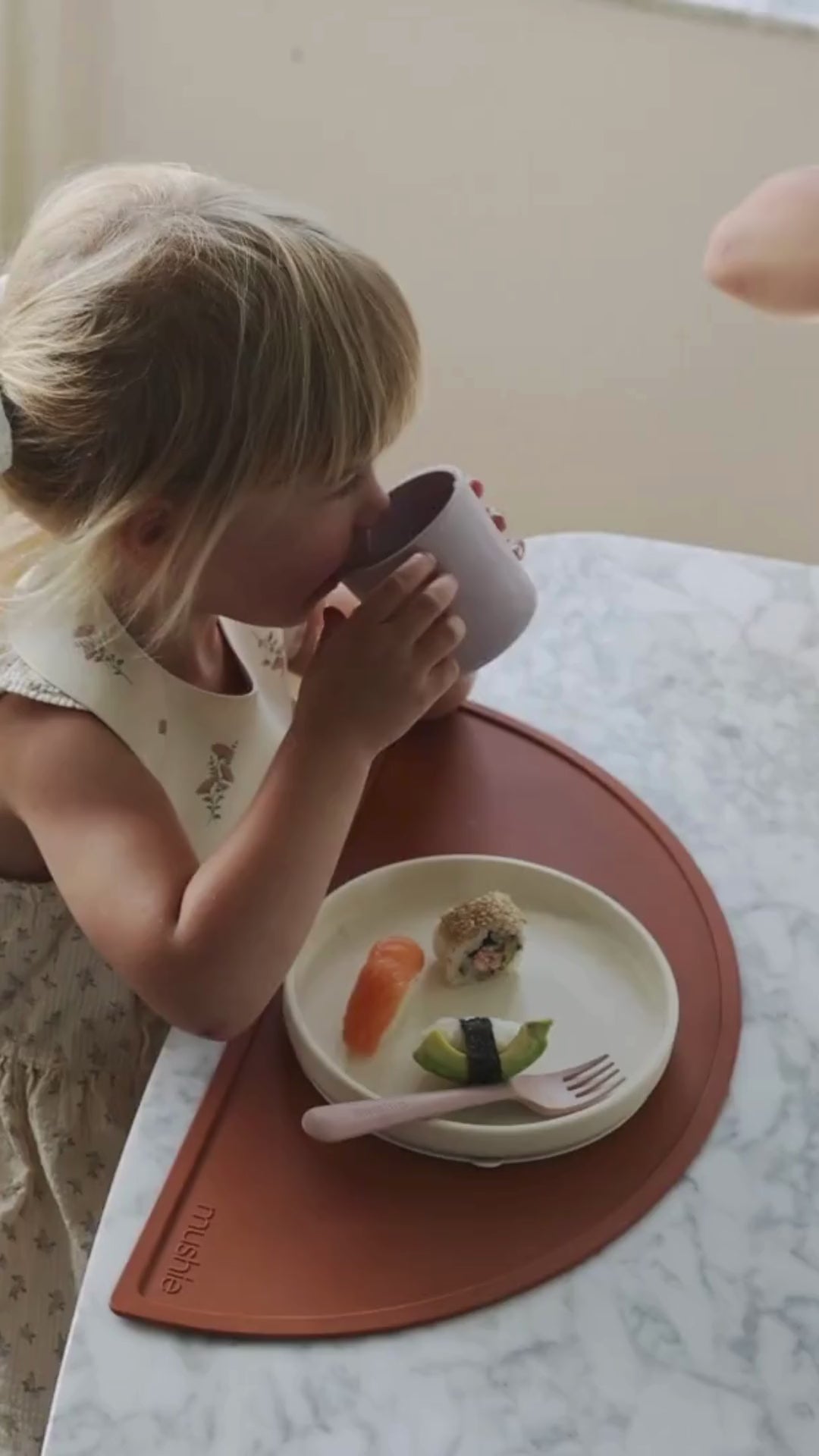
Drinking from an open cup.
Blowing bubbles.
Using a straw.
Making funny sounds.
Playing with water during bath time.
None of these activities are "spitting lessons."
Yet all of them help children build the coordination and body awareness that spitting eventually requires.
Development is rarely made up of isolated milestones.
More often, it's a collection of small experiences quietly connecting together.
Function Before Age
Parents naturally ask,
"What age should this happen?"
Professionals often ask a different question.
"What can this child do today?"
That difference matters.
Two children of exactly the same age may have very different oral-motor skills.
One may already hold water comfortably before spitting.
Another may instinctively swallow every sip.
Neither child is necessarily ahead or behind.
They're simply developing different skills at different speeds.
For this reason, Mummasphere encourages families to observe readiness rather than chase birthdays.
Some children begin showing signs such as:
- enjoying copying adults during brushing routines;
- understanding simple one-step instructions;
- holding small amounts of water briefly inside the mouth;
- becoming more coordinated with drinking from an open cup;
- showing curiosity about blowing, spitting, or making playful mouth movements.
These aren't a checklist.
Nor do they appear in exactly the same order.
They're simply reminders that development is something we observe—not something we schedule.
Separate the Skill from the Routine
One of the easiest mistakes adults make is assuming children should learn everything at once.
Think about what happens during a typical toothbrushing routine.
A young child is expected to:
- open their mouth,
- tolerate a toothbrush,
- follow brushing movements,
- avoid chewing the toothbrush,
- rinse with water,
- hold the water,
- remember not to swallow,
- and finally spit into the sink.
For an adult, these actions feel effortless.
For a toddler, they are eight different skills happening within just a few minutes.
When children struggle, it doesn't necessarily mean they are refusing to learn.
Sometimes, it simply means they are being asked to learn too many new things at the same time.
Learning One Skill at a Time
Imagine trying to learn to ride a bicycle while also learning to steer, balance, pedal, brake, and watch the traffic—all on your very first attempt.
Most of us would find that overwhelming.
Young children experience something remarkably similar during everyday routines.
Their brains are constantly deciding where to focus.
Should they remember to keep their mouth open?
Should they copy Mum's brushing movements?
Should they try not to bite the toothbrush?
Or should they remember to spit?
It's perfectly reasonable that something gets forgotten.
Not because children aren't capable.
But because learning has a natural limit.
At Mummasphere, we believe that reducing the learning load often makes learning more successful.
Sometimes the most supportive thing parents can do is make one small skill easier to practise.
Practising Outside the Brushing Routine
One simple way to reduce that learning load is to separate the skill of spitting from the brushing routine itself.
Instead of introducing everything during toothbrushing, children can explore the skill in relaxed, everyday moments.
Perhaps while playing with water in the bath.
Perhaps after drinking from an open cup.
Perhaps standing at the bathroom sink after washing their hands.
Using plain water, children can experiment without worrying about toothpaste, brushing technique, or finishing a routine correctly.
The focus becomes wonderfully simple.
"Let's see what happens if we try to spit the water out."
No pressure.
No urgency.
No expectation of getting it right immediately.
Just another opportunity to learn.
Learning Through Play
Children rarely realise they're practising developmental skills when they're playing.
That's one of the reasons play is such a powerful teacher.
Blowing bubbles across the garden.
Trying to move a feather across a table.
Blowing a pinwheel in the wind.
Making funny sounds in front of the mirror.
Taking turns pretending to be dragons breathing air.
None of these activities are designed to teach spitting directly.
Yet many of them strengthen the same coordination, breath control, and awareness that children gradually use when they begin rinsing and spitting after brushing.
The goal isn't to turn play into therapy.
It's simply to recognise that everyday play often becomes everyday learning.
When Progress Doesn't Look Like Progress
Parents sometimes tell us,
"Yesterday my child spat the water out perfectly. Today they swallowed everything again."
This can feel confusing.
In reality, it's one of the most normal parts of child development.
Progress is rarely a straight line.
Children move forwards.
Pause.
Seem to move backwards.
Then surprise everyone with a new burst of confidence a few weeks later.
Fatigue.
Teething.
Excitement.
Illness.
Changes in routine.
All of these can influence what a child is able to do on any given day.
Development isn't measured by yesterday's success.
It's measured by the gradual direction of growth over time.
Think Like Mummasphere
Before asking,
"Why can't my child spit yet?"
try asking,
"What smaller skill might my child be learning first?"
Sometimes they're learning to hold water in their mouth.
Sometimes they're learning to copy your actions.
Sometimes they're simply becoming comfortable standing at the sink.
Those small achievements often go unnoticed.
Yet they are the very foundations that make confident spitting possible later on.
One Child, Many Caregivers
Learning to spit rarely happens with just one adult.
One morning, Mum may encourage a child to rinse after brushing.
Later that day, Grandpa reminds them to "try spitting the water out."
At bedtime, Dad patiently demonstrates the movement again.
For many families, especially those where grandparents, nannies, or childcare educators play an important role, a child may practise the same skill with several different caregivers throughout the week.
Every adult brings their own habits.
Their own language.
Their own expectations.
Some may patiently wait for the child to try.
Others, wanting to help, might simply say,
"That's alright—just swallow it this time."
Neither response is wrong.
Both come from a place of care.
But children learn best when the adults around them are working towards the same goal.
Not perfection.
Consistency.
Building Shared Understanding
Healthy routines become easier when families share the same understanding—not necessarily the exact same technique.
Rather than expecting every caregiver to do everything identically, it can be helpful to agree on a few simple principles.
Perhaps everyone decides that:
- children are encouraged to try spitting but are never pressured to succeed;
- practice can happen with plain water outside brushing time;
- adults will demonstrate before expecting children to copy;
- effort is celebrated more than perfect results;
- and every attempt is treated as part of learning.
These conversations may seem small.
Yet they often make everyday routines feel far more predictable for children.
And predictability helps children feel safe.
Progress Doesn't Need to Be Perfect
There will be mornings when everything seems to click.
Your child spits confidently.
Smiles proudly.
Wants to do it again.
The next day, they swallow every mouthful of water.
Nothing has gone wrong.
Children's development isn't a straight line.
They grow through repetition, experimentation, and occasional setbacks.
Tiredness.
Teething.
A busy morning.
A new environment.
Excitement.
All of these can influence what children are able to do on any particular day.
Parents don't need to interpret every difficult day as a step backwards.
Sometimes it's simply another part of learning.
Mummasphere Family Habit
If you'd like to try one small change this week, make it this:
Create opportunities to practise spitting that have nothing to do with toothbrushing.
After drinking water.
During bath time.
While washing hands at the sink.
During playful moments that already feel relaxed.
Without toothpaste.
Without time pressure.
Without worrying about getting it right.
When children learn a skill in an environment that feels safe and playful, they're often more willing to use that skill later during brushing.
Sometimes the smallest changes in where children learn make the biggest difference in how they learn.
What Matters Most
If, a few months from now, you remember only a handful of ideas from this article, we hope they're these.
- Learning to spit is a developmental skill—not a race towards the next milestone.
- Age provides guidance, but a child's current abilities often provide better direction for everyday decisions.
- Children learn more successfully when new skills are introduced one step at a time.
- Consistent encouragement from every caregiver creates a stronger learning environment than perfect technique.
- The ultimate goal isn't learning to spit. It's helping children feel confident enough to keep learning.
Mummasphere Perspective
Parents often ask,
"When will my child finally learn to spit?"
It's an understandable question.
But perhaps there's another question that's even more helpful.
"How can I make learning feel safe enough that my child wants to keep trying?"
Every new skill begins long before mastery.
It begins with curiosity.
With imitation.
With small attempts that don't quite work.
With laughter when water goes everywhere except the sink.
And with adults who understand that learning rarely follows a perfect timeline.
Children don't need pressure to become capable.
They need opportunities.
They need encouragement.
They need everyday experiences that allow confidence to grow naturally.
At Mummasphere, we believe oral health isn't built through isolated milestones.
It's built through thousands of small moments that help children trust their own ability to learn.
Learning to spit may seem like a tiny achievement.
Yet the way families support that journey teaches something much bigger.
That making mistakes is part of learning.
That progress doesn't have to be perfect.
And that healthy habits are strongest when children are given the time, patience, and confidence to grow into them.
People Also Ask
- How Much Toothpaste Should a Baby Use?
- How to Brush Your Baby's First Teeth
- Choosing Your Baby's First Toothbrush
- How to Read a Toothpaste Ingredient List
- How to Compare Children's Toothpaste
Related topics:
Ingredient Guides:
- Fluoride in Children's Toothpaste
- Xylitol in Children's Toothpaste
- Hydroxyapatite in Children's Toothpaste
Packaging Claims - What It Really Means?: